Last updated 24 September 2026.
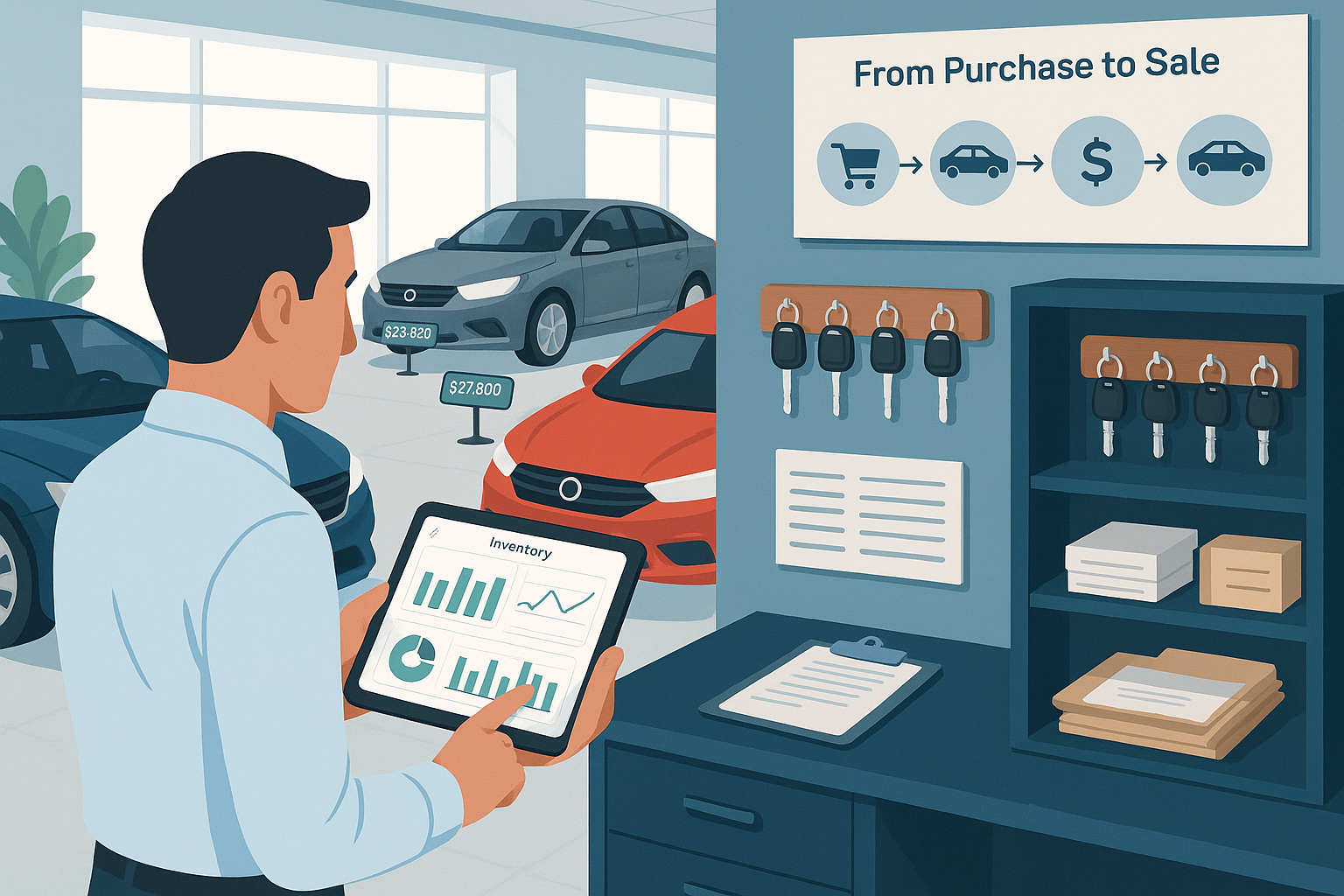
Good stock management means buying cars you can sell at a profit, getting them ready and advertised within days, and acting on price before they go stale. Every car on your forecourt is money tied up, and the longer it sits, the more it costs you in funding, depreciation and space. This guide follows a car from the day you buy it to the day it leaves, with the checks that keep stock moving.
The vehicle lifecycle
Every car you sell goes through the same six stages, and each one can cost you time or margin:
- Acquisition: buying at auction, taking a part exchange or buying from a private seller
- Preparation: mechanical work, MOT, cosmetic repairs, valeting and photos
- Listing: putting the car on your website and the advertising sites
- Marketing: promoting it through search, social media and marketplace adverts
- Sale: enquiries, test drives, negotiation and the invoice
- After the sale: finance paperwork, handover and follow-up
If you only look at the car when it sells, you won’t know which stage is slowing you down. Tracking each car through every stage in your stock management system shows you where the days and the money go.
Acquisition: buying the right stock
Buy cars you already know you can sell, at a price that leaves room for preparation and profit. The margin on a car is mostly made or lost on the day you buy it.
Buy from the market, not from gut feel
Before you bid or agree a part exchange figure, answer four questions:
- What is selling? Look at your own sales history and at what is moving on the marketplaces.
- What margin is there? Compare the trade price with a realistic retail price in your area.
- How quickly will it sell? Cars with strong demand and few similar adverts go faster.
- What will it need? Estimate the preparation cost before you agree a price, not after.
Our dealer management system shows AutoTrader valuations on each car, and CAP HPI valuations if you add them, so you have the figures in front of you at auction or when appraising a part exchange. For the channels themselves, see where UK dealers buy their stock.
Record everything on day one
Add the car to your stock records the day you buy it, with:
- The vehicle details, filled in from the registration
- The purchase price and who you bought it from
- The VAT status: margin scheme or VAT qualifying
- Where it came from: auction, part exchange, private seller or trade
Every later figure, from the preparation budget to the final profit, is worked out from these. If the purchase record is wrong, so is everything after it. Buying from a private seller? Our guide to putting a car into the trade covers the DVLA side.
Preparation: getting cars ready for sale
Preparation is where most dealers lose margin without noticing, usually in one of three ways: cars wait too long in the workshop, preparation spend creeps past what the margin can carry, or poor photos cut the number of enquiries.
Keep preparation costs on the car
Record every cost against the car it was spent on, in your DMS:
- Mechanical repairs and servicing
- MOT work
- Smart repairs, paint touch-ups and alloy wheel refurbishment
- Valeting
- Photography
Added to the purchase price, these give you the stand-in value of the car at any point. Without them, a car can look profitable on paper and barely break even once the invoices are in. In Haswent, you add costs from your own list of regular costs, and each car’s stand-in value updates as you go.
Set a preparation deadline
Set a target number of days from purchase to going live online, and check it. For many independent dealers, three to five working days is realistic. Longer than that and you are paying for a car that is not getting enquiries.
When a car overruns, find out why: waiting for parts, workshop time, photos or the listing itself. Running preparation on task boards keeps each step visible, and you can have the preparation tasks created automatically when a car is added to stock.
Listing: getting cars in front of buyers
List each car everywhere your buyers look as soon as it is ready. A car that is ready but not advertised is the most expensive kind of stock.
Your dealer website
Your dealer website is where marketplace buyers often end up before they call. Each car needs:
- Plenty of photos, inside and out
- Accurate specification
- A clear price, with monthly finance figures if you offer finance
- A description that picks out what makes this car worth buying
Marketplace adverts
Send your stock to the marketplaces your buyers use:
- AutoTrader, the biggest UK car marketplace
- CarGurus, where buyers compare prices
- Motors, for extra reach
- Other portals such as eBay Motors
In Haswent, AutoTrader adverts are created and updated from your stock records, and data feeds send your stock to other portals and partners, so price changes and sold cars follow through without logging in to each site.
Google Vehicle Ads
Google Vehicle Ads show your actual cars, with a photo and price, at the top of Google when someone searches for that make and model. In our Google Vehicle Ads guide, one dealer had 23.9k visitors, 1.66 million impressions and 350 conversions in three months.Pricing strategy
Price to the market from day one, then review each car at set points as it ages. Too high and the car sits. Too low and you give away margin you didn’t need to.
Price from market data
Set each price against:
- Similar cars advertised locally and nationally
- How long those cars are taking to sell
- The minimum profit you will accept on this car
With an AutoTrader connection, the Insights tab on each car in Haswent compares it with similar adverts: how many there are, their average and lowest prices, and how many are cheaper than yours. See vehicle insights for what else that tab shows.
Review prices by stock age
Decide in advance when each car gets looked at again:
- At 14 days, check where it sits against the market.
- At 30 days, drop the price if enquiries are low.
- At 45 days, take firmer action to move it.
- At 60 days, decide whether to cut it hard, send it to auction or sell it to the trade.
Your stock list should show days in stock for every car, so the cars that need attention are easy to spot before they become a problem.
Social media and marketing
Post your stock on social media as well as listing it. A regular social media presence keeps your cars in front of local buyers who are not searching yet:
- New arrivals as soon as they are ready
- Price drops
- Sold cars, which show buyers that stock moves
- Preparation and workshop videos, and the people on your team
Haswent posts your stock to your Facebook page on a schedule you set, with your own wording and branded images, so posting doesn’t depend on someone finding the time.
Monitoring performance
Track four numbers every week: days in stock, profit per car, stock turn and preparation spend. If you don’t measure them, you can’t tell whether a change to buying or pricing worked.
Days in Stock
Average time from purchase to sale. Many dealers aim for under 45 days
Gross Profit
Profit on each car after every cost is taken off
Stock Turn
How many times your stock sells through in a year
Recon Costs
Average preparation spend as a percentage of the retail price
In our dealer management system, the stock book, stock on date and vehicle holding reports show what you bought, sold and held, what it cost and the profit made. The same records feed your invoices; our dealer invoice management guide covers that side.
Before you buy, it is also worth a history check. Our MotorCheck integration lets you run one from the car’s record.
Frequently Asked Questions
What is a good average days in stock for a car dealer?
There is no official benchmark, but many independent used car dealers work to an average of 30 to 45 days in stock. A car still unsold after 60 days usually needs a price change or a decision to sell it to the trade, because it is tying up money you could spend on the next car.
How should dealers track reconditioning costs?
Record every cost against the car it was spent on, not against the business as a whole. That means mechanical repairs, MOT work, smart repairs, valeting and anything else spent before the car is ready for sale. Adding them to the purchase price gives you the stand-in value, which is the only way to see the real profit on each car.
What is the best way to advertise dealer stock online?
List every car on your own dealer website and on the marketplaces your buyers use, such as AutoTrader, CarGurus and Motors. Send them from one set of stock records using data feeds, so prices and sold cars change everywhere at once instead of being updated by hand on each site.
Manage your stock in one place
Haswent keeps each car’s purchase, costs, adverts, price history and sale in one record, from the day you buy it to the day it leaves. Our dealer management system is built for UK car dealers.
Get in touch with our team to see how it would work with your stock.