Last updated 24 September 2026.
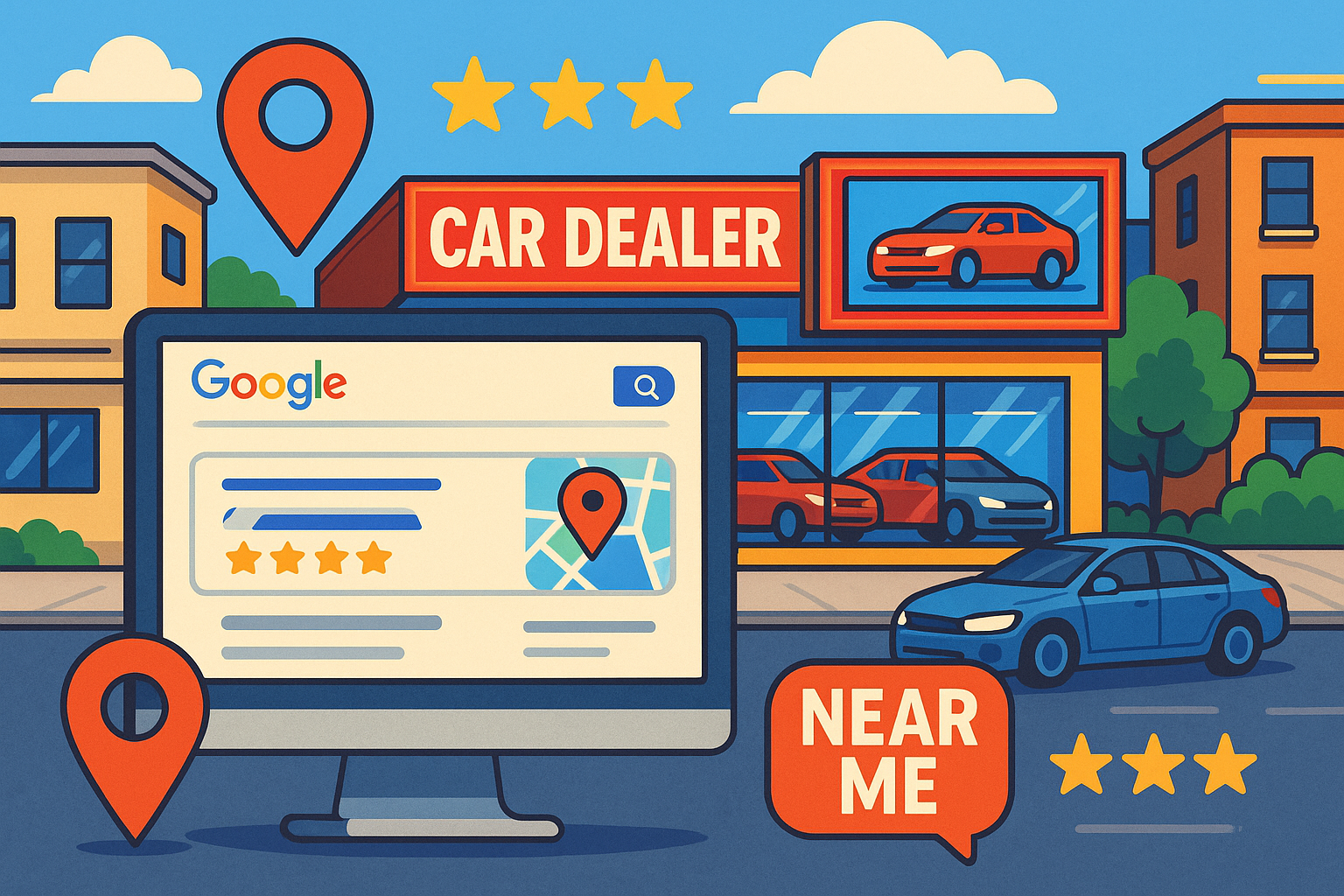
Local SEO is how you get your dealership into the map results and the top of Google when someone nearby searches “car dealer near me” or “used cars in [your town]”. The biggest levers are a complete, verified Google Business Profile, a steady flow of Google reviews, and the same name, address and phone number everywhere you’re listed. None of it costs anything per click, and once it’s in place it keeps bringing in calls, enquiries and visits.
This guide covers how local search works, what to do on your Google Business Profile and your website, where to get listed, and how to tell whether it’s working.
How do car dealers rank higher in local search?
Verify your Google Business Profile and fill in every section, ask every happy customer for a Google review and reply to them all, and make sure your business name, address and phone number match on your website and every directory. Google ranks local results on relevance, distance and prominence, and these steps improve the two you can control.
How local search works for car dealers
Google shows local searches in two places: the map pack at the top, and the ordinary results underneath.
The map pack
The map pack is the map with three businesses under it that usually appears above the ordinary results. Each one shows the business name, star rating, address, phone number and opening hours, with buttons to call or get directions. Being in it puts you in front of buyers before they’ve looked at a single website.
Ordinary local results
Below the map pack are the ordinary results, which depend on normal SEO as well as local signals. Your dealer website needs to rank here for the buyers who scroll past the map. Our dealer SEO guide covers that side in more detail.
Google says local results are based on three things:
- Relevance: how well your business matches the search.
- Distance: how far your dealership is from the person searching.
- Prominence: how well known your business is, which includes how many reviews you have and your rating.
You can’t move your premises, but you can do a lot about relevance and prominence.
Your Google Business Profile
Your Google Business Profile (GBP) is the free listing that controls how your dealership appears in Google Maps and the map pack. It matters more to local search than anything else on this list.
Setting it up and verifying
If you haven’t already, claim and verify your profile:
- Go to business.google.com and search for your dealership.
- Claim the listing if one exists, or create a new one.
- Verify it. Google decides which methods you’re offered, which can include a phone call or text, email, a video recording, a live video call or a postcard.
Filling in your profile
Fill in every section. Each one gives Google something to match against a search.
- Business name. Use your real business name. Google’s guidelines don’t allow extra keywords or locations in the name, and a profile that breaks them can be suspended.
- Primary category. Choose “Used car dealer” or “Car dealer”. Add secondary categories such as “Car finance provider” or “Vehicle inspection service” only if you offer them.
- Address. Write it exactly as it appears on your website and every other listing.
- Phone number. Use a landline with a local area code rather than a mobile. It looks like an established business.
- Opening hours. Keep them accurate, including bank holidays and seasonal changes. Google shows whether you’re open right now.
- Description. Say what you sell, where you are, what you specialise in and why people buy from you. Mention your town naturally, for example “used car dealer in [town]“.
- Services. List everything you offer: used car sales, part exchange, finance, warranties, vehicle appraisals, servicing.
Add photos regularly:
- the outside of your premises, so buyers recognise it when they arrive
- inside your showroom
- your current stock, kept up to date
- your team
- customer handovers (with the customer’s permission)
Google Business Profile posts
You can publish posts straight onto your profile about offers, new stock and news, and they show on your listing. Post at least weekly so the profile looks active. Haswent can also post each car in your stock to your Google Business Profile, replacing the post when the price changes, once we’ve connected your profile.
Google reviews
Reviews help you rank locally and help buyers decide whether to call you. A dealer with 150 good reviews looks a much safer bet than one with 10.
Getting more reviews
- Ask every happy customer. Asking straight after a sale or handover is what works best.
- Make it easy. Send them a direct link to your Google review page by text or in your follow-up email, or print it on a card.
- Reply to every review. Thank people for good reviews and deal with bad ones professionally.
- Don’t offer anything in return. Google’s policies ban discounts, gifts or payment in exchange for reviews. They also say you shouldn’t pressure customers to leave a review while they’re at your premises, or set staff targets for a number of reviews.
Haswent’s review requests ask each customer to rate their experience when a deal closes, and point happy customers to Google, AutoTrader, Facebook and more.
Replying to negative reviews
Bad reviews happen to every dealer. The way you reply matters more than the review, because other buyers read both.
- Reply promptly and stay professional.
- Acknowledge the customer’s problem.
- Offer to sort it out offline, with a name and phone number to contact.
- Don’t argue or get defensive.
Local SEO on your dealer website
Your website needs to make it obvious to Google which area you serve. These are the parts to get right.
Page titles and meta descriptions
Your homepage title should include your town, for example:
- “Used Car Dealer in [Town] | [Business Name]”
- “Quality Used Cars for Sale in [Town] | [Business Name]”
Give every page its own title with the words people search for, and your location where it fits naturally.
Local content
Mention the area you serve in a way that helps buyers:
- Name your town and the surrounding areas naturally across the site.
- Give directions to your premises and mention nearby landmarks.
- Write about local topics, such as ULEZ or a clean air zone near you, local road changes or community work you do.
Schema markup
Add LocalBusiness schema markup to your website. This structured data tells Google your business name, address, phone number, opening hours, map location and business type in a format it reads directly. Vehicle pages should carry vehicle schema too. Our guide to schema markup for dealer websites has examples of both.
NAP consistency
NAP stands for name, address and phone number, and it should be written the same way on your website, your Google Business Profile and every other listing. Small differences such as “Road” and “Rd”, or “01234 567890” and “+44 1234 567890”, can blur Google’s picture of your business.
Local citations
Citations are mentions of your business name, address and phone number on other websites. They help confirm to Google that you exist at that address.
Where UK dealers should be listed
General directories:
- Yell.com
- Thomson Local
- Yelp UK
- FreeIndex
- Cylex UK
- 192.com
Motor trade sites:
- AutoTrader
- Motors.co.uk
- CarGurus
- eBay Motors
- Trustpilot (automotive category)
Social profiles:
- Facebook (with your address and phone number)
- Instagram (business profile with contact details)
- LinkedIn (company page)
Maps and other search engines:
- Apple Maps
- Bing Places
- Waze
Keeping citations consistent
Every listing should use exactly the same business name, address and phone number. Check the listings you already have and correct any that differ, because mismatched details weaken your local signals.
Local links
Links to your website from other local websites tell Google you’re an established part of the community. Good places to get them:
- Local press: sponsor an event, support a charity or get featured in a local news story.
- Business partners: finance providers, warranty companies and local service businesses often list the dealers they work with.
- Industry listings: the FCA register and trade body directories.
- Community work: local sports teams, school events and community projects usually link to their sponsors.
- Local business groups: your Chamber of Commerce, networking groups and business improvement districts.
Content for local SEO
Blog posts about your area give Google more pages to rank for local searches. Ideas that work for dealers:
- “Best used cars for city driving in [Town]”
- “ULEZ-compliant cars at [Business Name]”
- “How to choose a car dealer in [Area]”
- “A guide to buying a car in [County]”
- customer stories that mention where they’re from
Only publish it if it answers a real question. A page that just repeats your town name won’t rank for long. Once local buyers land on your site, the next job is turning visits into appointments, which we cover in how to get more test drive bookings from your website.
How to measure local SEO
Check these each month to see whether your local SEO is working:
- Google Business Profile performance: how many people viewed your profile, what they searched for, and how many called or asked for directions.
- Local rankings: where you appear for searches like “used cars in [town]“.
- Organic traffic: visitors from search in Google Analytics.
- Phone calls: ask every new enquiry how they found you.
- New reviews: how many you’re getting each month, not just the total.
Frequently asked questions
How do I get my car dealership to appear in Google Maps?
Create and verify a Google Business Profile for your dealership, then fill in every section: business name, address, phone number, opening hours, categories, photos and description. Ask customers for reviews and keep the profile up to date to improve where you appear in Maps.
What are local citations and why do they matter for dealers?
Local citations are mentions of your business name, address and phone number on other websites, such as directories, industry listings and social media profiles. When those details match everywhere, Google can be more confident your business is real and where you say it is, which helps your local rankings.
How important are Google reviews for local SEO?
Very. Google says more reviews and positive ratings can help your local ranking, and the number of reviews you have counts towards how prominent your business is. Reviews also affect whether buyers click on you at all, because they trust dealers with a strong review history.
Where to start with local SEO
Local SEO needs regular attention rather than a one-off fix. Start with your Google Business Profile, then reviews, then your citations, then your website.
For a sense of what else makes a dealer website work once buyers arrive, read what makes a great dealer website. If you’d like a website with local SEO built in, get in touch with our team about Haswent dealer websites.
Sources
- Google Business Profile Help: Tips to improve your local ranking on Google
- Google Business Profile Help: Verify your business on Google
- Google Business Profile Help: Guidelines for representing your business on Google
- Google Maps Help: Prohibited and restricted content (incentivised reviews)